

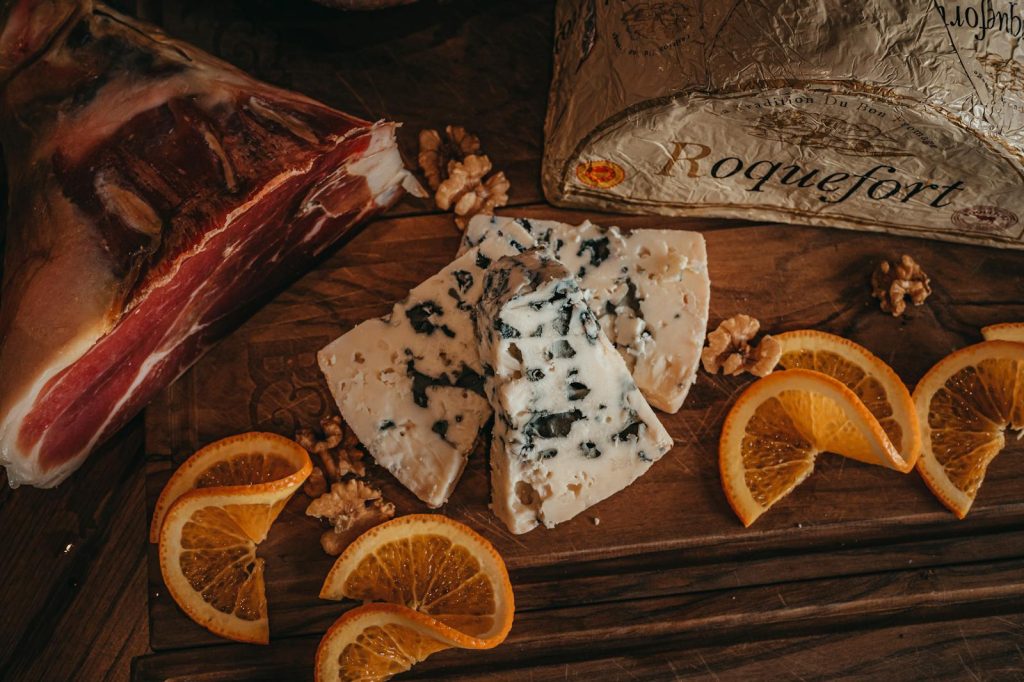
Roquefort — for many THE French blue cheese, and one of the oldest cheeses in the world whose existence is documented in writing. A raw-milk sheep’s cheese with intense blue-green veins, ripened in the centuries-old caves of a village in southern France. But what exactly is roquefort, how does it differ from gorgonzola, and can you eat it during pregnancy? We explain.
What exactly is roquefort?
Roquefort is a French blue cheese with PDO status (AOP in French: Appellation d’Origine Protégée). The name may only be used for cheese that meets very strict rules — one of the first cheeses in the world to receive this legal protection, as early as 1925.
Three things make roquefort unique:
- Sheep’s milk: roquefort is made exclusively from raw milk of Lacaune sheep, a specific breed from the Aveyron region in southern France.
- Combalou caves: ripening takes place in the natural limestone caves beneath the village of Roquefort-sur-Soulzon. Cool, damp air constantly flows through cracks in the mountain — the so-called fleurines — creating the unique microclimate that allows the mould to grow.
- Penicillium roqueforti: the mould that gives roquefort its blue-green veins owes its name to this cheese. It was traditionally harvested from mouldy rye bread left in the caves.
The history of roquefort
Roquefort is no modern invention. The Roman historian Pliny the Elder mentioned the cheese as early as AD 79 in his Naturalis Historia, and according to legend Charlemagne was smitten with it in the 9th century. He even had two cart-loads brought to his palace each year — quite a statement of appreciation for the time.
The origin of the mould is explained by a romantic tale: a shepherd is said to have left his lunch (bread and sheep’s cheese) in a cave to chase after a beautiful shepherdess. When he returned weeks later, the bread was mouldy and the mould had spread to the cheese. He dared to taste it anyway — and so roquefort was born. True or not, the story is part of the cheese.
Roquefort, gorgonzola or stilton: three blue cheese icons
The three most famous blue cheeses in the world — all three iconic, all three very different:
- Roquefort (France, sheep’s milk, raw): sharp, salty, with a pronounced sheepy note and a complex vein structure.
- Gorgonzola (Italy, cow’s milk, pasteurised): creamier and milder as Dolce, intense as Piccante. Gentler in character than roquefort.
- Stilton (England, cow’s milk, pasteurised): crumbly, drier, with its own English nutty style. A classic with port.
If you’re new to blue cheese, start with Gorgonzola Dolce. If you want the sharpest, most characterful: roquefort.
For blue-cheese fans: discover also Shropshire Blue — a British variety with striking orange colour.
How is roquefort made?
The process has remained virtually unchanged over the centuries:
- Milk: raw Lacaune sheep’s milk, only between December and July (the sheep’s natural lactation period).
- Curdling: in copper vats with natural rennet.
- Inoculation with mould: Penicillium roqueforti spores are added to the curd.
- Moulding: the mass is poured into moulds and drained.
- Piercing: after a few days the wheels are pierced with long needles so that oxygen reaches the mould, which can then grow and form the characteristic blue-green veins.
- Ripening in the Combalou caves: at least three months in the natural caves beneath the village. Nothing can replace them: the fleurines (natural ventilation cracks in the mountain) provide the exact microclimate that makes roquefort unique.
See also why connoisseurs prefer raw-milk cheese for the nuances.
Is roquefort healthy?
Roquefort has a few specific traits compared to other blue cheeses:
- Sheep’s milk: higher in protein, calcium and B12 than cow’s milk. Many people find it easier to digest.
- Protein: 19-22 grams per 100 grams.
- Fat: 30-32 grams per 100 grams — high. Roquefort is a full-fat cheese.
- Lactose: almost absent due to ripening. Often well tolerated by people with mild lactose sensitivity.
- Salt: relatively high. Enjoy in moderation, especially with high blood pressure.
Roquefort isn’t an everyday cheese, it’s an experience. A few grams over a salad or a small piece on a cheese board goes a long way.
Roquefort during pregnancy: what’s the advice?
The advice is: avoid roquefort during pregnancy. Roquefort falls into two risk categories at once:
- Raw milk: Listeria bacteria can survive in raw milk.
- Soft mould-ripened cheese: the moist, mouldy environment is favourable for Listeria growth.
This advice is in line with the guidelines of the Dutch Nutrition Centre and RIVM, and applies to all raw-milk blue cheeses. For a French cheese vibe during pregnancy, choose a long-aged hard cheese such as Parmigiano Reggiano (aged more than 12 months — safe to eat). Also read our article on what is parmesan cheese for more background.
For the full picture, check our cheese and pregnancy guide.
What pairs well with roquefort?
Roquefort is intense, so combine it cleverly — especially with things that soften or amplify the salt and bite:
- With Sauternes: the classic pairing. A sweet dessert wine from Bordeaux balances the saltiness perfectly. One of the most legendary cheese-and-wine pairings in the world.
- With walnuts and pears: the Italian saying “don’t tell the farmer how good cheese is with pears” applies to roquefort too.
- On a salad: roquefort crumbled over a green salad with walnuts, pear and a mustard dressing — a French bistro classic.
- In a steak marinade or sauce: roquefort sauce on steak is THE combination in French brasseries.
- With honey and figs: sweet notes against salty bite.
- With port or a full-bodied red: an old-school Tawny port or a rich Côtes du Rhône, Bordeaux or Cahors.
- On dark bread: rye bread or a good sourdough.
Tip: always serve roquefort at room temperature — take it out of the fridge 30 minutes before serving. The aromas only really come into their own at 18-20 °C.
Tip: see our cheese board guide for tips on balancing flavours and textures.
See also our cheese-and-wine guide for more inspiration.
Our cheeses
At Cheese In A Box we don’t carry roquefort in our regular range — a raw-milk blue cheese that comes ripened straight from the Combalou caves requires a supply chain that doesn’t suit our fresh-cut-on-order approach. For blue cheese lovers wanting blue on the board, we do have strong Italian alternatives:
- Gorgonzola — a sharper Italian blue, closer to roquefort in intensity.
- Gorgonzola Dolce — milder and creamier, perfect as an introduction to blue cheese.
- Parmigiano Reggiano — for those who want character and intensity in a different style.
- Pecorino — Italian sheep’s cheese with a savoury bite.
Want to discover a new artisanal cheese every month? With our cheese subscription every delivery brings a surprising selection of cheeses — French, Italian, Dutch and more — straight to your door.
Discover our Dutch main category in our farmhouse cheese article.