

Camembert, one of the most iconic French cheeses in the world. A small, intense round wheel of white-rind cheese from Normandy, with an aroma that ranges from mushroom to damp earth. But what exactly is camembert, what’s the difference between camembert and brie, and is it safe to eat during pregnancy? We break it all down.
What exactly is camembert?
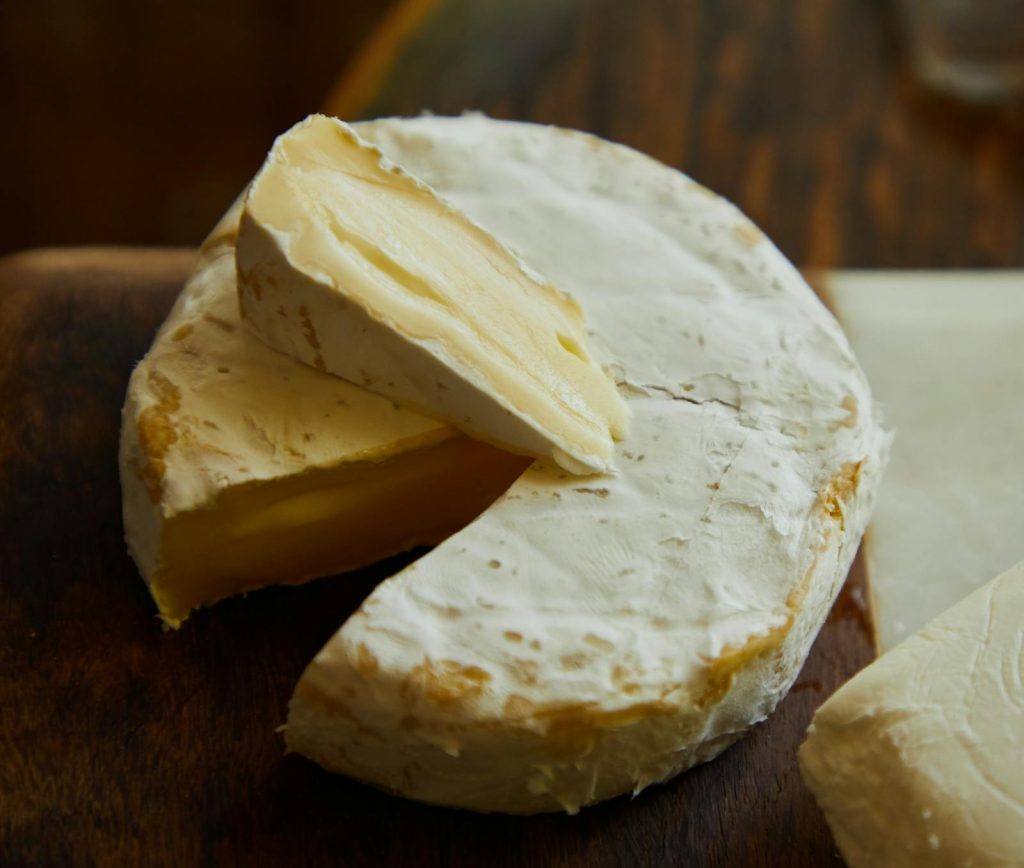
Camembert is a soft French cow’s milk cheese with a white rind, originating in Normandy. Legend has it that a farmer’s wife from the village of Camembert, Marie Harel, invented it in 1791, with help from a priest who had taken refuge with her after fleeing the Brie region and shared his cheese-making knowledge.
The cheese is made in small round wheels of about 11 cm in diameter and 250 grams. Like brie, camembert gets its white exterior from the mold Penicillium camemberti, which grows on the surface and ripens the cheese from the outside in. That’s why a good camembert becomes so wonderfully soft: the mold slowly breaks down the protein, and the older the cheese, the more liquid the interior becomes.
Wider context in our overview of white-rind cheese varieties and pairings.
Camembert de Normandie AOP or regular camembert?
“Camembert” is, contrary to what many people think, not a fully protected name. Anyone in the world can call their cheese “camembert.” What is protected is the specific name Camembert de Normandie AOP. That name may only be used for cheese that meets strict requirements:
- Raw milk: exclusively from Normandy cows, unpasteurized.
- Hand-ladled: the curds are traditionally spooned by hand into the molds in layers (moulé à la louche), not by machine.
- Production area: only within a defined zone in Normandy.
- Aging: a minimum of 21 days.
“Camembert” without the AOP designation can come from anywhere, be made from pasteurized milk, and be machine-molded. This type of cheese is generally milder and cheaper. Not necessarily worse, but a different experience from a raw-milk Camembert de Normandie AOP.
Camembert vs. brie: what’s the difference?
The two most-compared French white-rind cheeses. At first glance they look almost identical: both round, white on the outside, soft and melting within. But there are clear differences:
- Size: brie is large (27-36 cm), camembert small (11 cm). A whole camembert weighs 250 grams, a whole brie 2.5 kilos.
- Origin: brie from Île-de-France (the Brie region), camembert from Normandy.
- Flavor: brie is more refined, creamy and mild. Camembert is more intense, with a stronger mushroom and earthy cabbage note. Because of its smaller size and shorter aging time, camembert develops character more quickly.
- Raw milk: authentic Camembert de Normandie AOP is made from raw milk. So is Brie de Meaux AOP, but most “brie” in the supermarket is pasteurized.
For a first introduction to white-rind cheese: go with brie. If you want more character and intensity: camembert. As far as we’re concerned, both belong on a great cheese board.
How is camembert made?
Making Camembert de Normandie AOP is a true craft. The main steps:
- Milk: raw cow’s milk from Normandy cows.
- Curdling: in copper vats using natural rennet.
- Moulé à la louche: the curds are hand-ladled into the molds in five successive layers over the course of about an hour. This gives camembert its characteristic texture.
- Draining: the molds are left to stand for 12-24 hours to allow the whey to drain off.
- Salting: dry-salted on the surface.
- Inoculation: the surface is sprayed or dusted with Penicillium camemberti spores.
- Aging: a minimum of 21 days in a cool, humid aging room. The mold grows, the rind turns white, and the interior gradually softens and becomes more yielding.
Unlike hard cheeses that age for months or years, camembert is ready in just three weeks. That said, you can age it longer: some enthusiasts wait 6-8 weeks for a truly liquid center and intense flavor.
Background in our guide on raw-milk cheese.
Can you eat the white rind?
Yes, the white rind of camembert is completely edible and, in fact, it’s part of the whole experience. The rind is the Penicillium mold that made the cheese what it is, contributing to its flavor, aroma, and complexity. Cutting it off is a bit like eating pizza without the crust.
The only reason to skip it: if the cheese is clearly past its best. Signs to watch for include a strong ammonia smell, a sticky or slimy rind, or brownish discoloration. If you notice those, it’s best to leave it.
Is camembert healthy?
Camembert is nutritious, but it’s not a light cheese:
- Protein: 19-21 grams per 100 grams.
- Fat: 23-25 grams per 100 grams. A full-fat cheese.
- Calcium: a good source.
- Lactose: still contains some lactose, less than fresh cheeses but more than long-aged hard cheeses.
- Salt: relatively mild compared to feta or pecorino.
Because of its small size, it’s easy to finish a whole camembert in one sitting: a full 250-gram wheel already contains over 600 kcal. Enjoy it in moderation and be mindful of portion size. A classic serving is half a wheel for two people on a cheese board, or a whole camembert for an evening of snacking with friends.
Camembert during pregnancy: what’s the advice?
As with brie, the same applies here: avoid camembert during pregnancy. Camembert falls into the category of soft mold-ripened cheeses where Listeria can multiply, even when the milk has been pasteurized.
- Raw-milk Camembert de Normandie AOP: definitely avoid. The combination of raw milk, high moisture content, and a short aging period makes it a higher-risk cheese.
- Pasteurized camembert: also avoid, per the advice of the Voedingscentrum/RIVM. Listeria can still multiply on the soft mold surface after production.
Safe alternatives for a French cheese experience during pregnancy: choose a long-aged hard cheese like Parmigiano Reggiano or a good aged farmhouse cheese. Also check out our article on what is Parmesan cheese for more guidance on eating cheese during pregnancy.
See also our article on cheese during pregnancy — we explain per cheese type what is safe and what to avoid.
What goes well with camembert?
Camembert works beautifully both served as-is and warmed up. Classic pairings:
- On bread: a thick slice of rustic bread, a piece of camembert, a thin sliver of apple or pear. Simple and perfect.
- On a cheese board: with grapes, figs, apple, pear, and walnuts. Add a spoonful of honey or fig jam.
- Warm from the oven: place a whole camembert in its wooden box, poke a few holes in the top, add a clove of garlic and some thyme, and bake at 180°C for 15 minutes. Serve with a baguette for dipping.
- With cider and calvados: the Normandy holy trinity. Local cheese and local drinks, unbeatable.
- With red wine: a red Bordeaux or Pinot Noir.
- Deep-fried: breaded camembert pieces with cranberry sauce, a more contemporary preparation.
The most important tip, just as with brie: always serve at room temperature. Take it out of the fridge 30-60 minutes before eating. A cold camembert is half the flavor. At 18-20°C, the aroma and that melting texture really come into their own.
More ideas in our article on putting together a cheese board.
Dive deeper in our article on cheese and wine pairings.
Our cheeses
We don’t carry camembert as a regular item at Cheese In A Box. Like other soft white-rind cheeses, it requires a daily supply chain that doesn’t fit our fresh-cut-on-order approach. But for a French cheese board or a great evening in, we do have some strong alternatives:
- Parmigiano Reggiano, for those who love character and complexity.
- Pecorino, Italian sheep cheese with a savory bite.
- Gorgonzola Dolce, a soft blue cheese to pair alongside a camembert on the board.
- Gorgonzola, bolder and more pungent, for the true enthusiast.
Want to discover a new artisanal cheese every month? With our cheese subscription, every delivery brings a surprising selection of cheeses, from Dutch farmhouse cheese to international classics, straight to your door.
{ “@context”: “https://schema.org”, “@type”: “FAQPage”, “mainEntity”: [ { “@type”: “Question”, “name”: “What is the difference between camembert and brie?”, “acceptedAnswer”: { “@type”: “Answer”, “text”: “Brie comes from Île-de-France and is made in large flat wheels of 27-36 cm, with a more refined, creamy and mild flavor. Camembert comes from Normandy and is made in small round wheels of 11 cm and 250 grams, with a more intense flavor and a stronger mushroom and earthy note. Both use the same white mold (Penicillium camemberti). Camembert de Normandie AOP is always made from raw milk; supermarket brie is more often pasteurized.” } }, { “@type”: “Question”, “name”: “Is it safe to eat camembert during pregnancy?”, “acceptedAnswer”: { “@type”: “Answer”, “text”: “No, the advice from the Voedingscentrum is to avoid camembert during pregnancy. Camembert is a soft mold-ripened cheese where Listeria can multiply, including in pasteurized versions due to contamination during production. For a safe French cheese experience during pregnancy, choose a long-aged hard cheese like Parmigiano Reggiano or a good aged farmhouse cheese.” } }, { “@type”: “Question”, “name”: “Can you eat the white rind of camembert?”, “acceptedAnswer”: { “@type”: “Answer”, “text”: “Yes, the white rind of camembert is completely edible and is very much part of the cheese. It’s made up of Penicillium camemberti mold, which is what made the cheese what it is. Cutting it off is a bit like eating pizza without the crust. Only if the cheese has a strong ammonia smell, a sticky rind, or brownish discoloration is it past its best and best left uneaten.” } }, { “@type”: “Question”, “name”: “What is Camembert de Normandie AOP?”, “acceptedAnswer”: { “@type”: “Answer”, “text”: “Camembert de Normandie AOP is the PDO-protected version of camembert. Strict rules apply: only raw milk from Normandy cows, hand-ladled in layers into the molds (moulé à la louche), produced within a defined area in Normandy, and aged for a minimum of 21 days. Regular ‘camembert’ can come from anywhere, be pasteurized, and be machine-made. The AOP version has a more intense and complex flavor.” } }, { “@type”: “Question”, “name”: “What is the best way to serve camembert?”, “acceptedAnswer”: { “@type”: “Answer”, “text”: “Always serve camembert at room temperature. Take it out of the fridge 30-60 minutes before eating. At 18-20°C, the aroma and melting texture really come into their own. Classic serving ideas: on rustic bread with apple or pear, on a cheese board with grapes and walnuts, warm from the oven with garlic and thyme in its wooden box (15 minutes at 180°C), or with cider and calvados for a true Normandy pairing.” } } ] }Strong in our shop: see also our article on Dutch farmhouse cheese.