

Manchego — for many, a synonym for Spanish tapas: a few slices of a yellow, aged sheep’s cheese next to a slice of jamón, a handful of olives and a glass of red wine. But Manchego is much more than tapas filler. It’s a centuries-old PDO cheese with a leading role in Spanish culture. We explain what Manchego is exactly, what its ageing stages are, and how best to serve it.
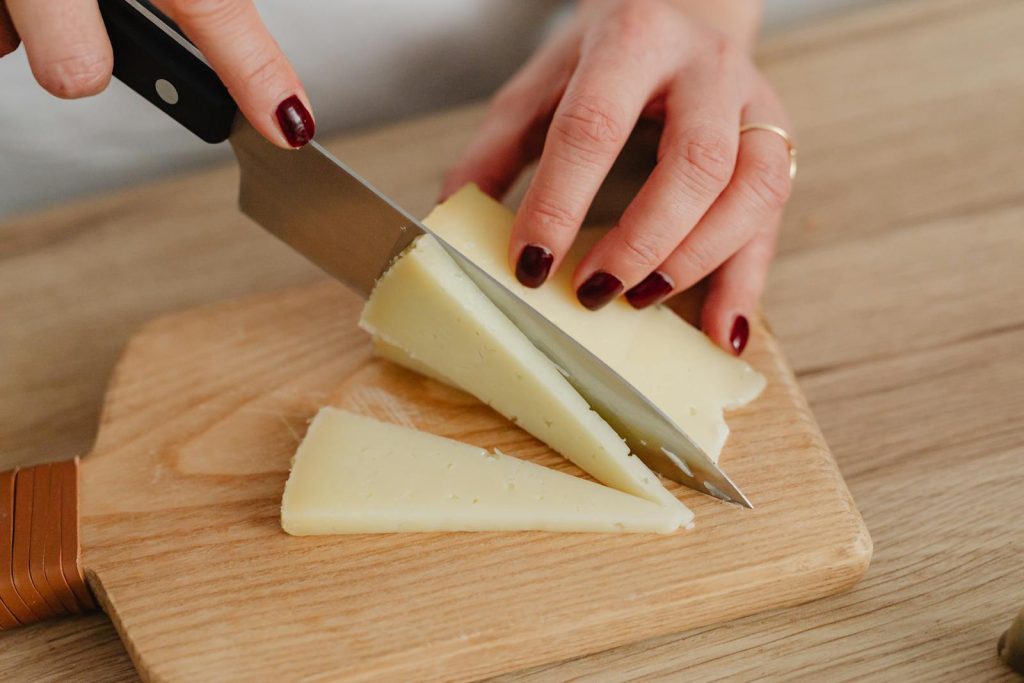
What is Manchego exactly?
Manchego — officially Queso Manchego DOP — is a Spanish hard to semi-hard sheep’s cheese with PDO status (in Spanish: Denominación de Origen Protegida). The name may only be used for cheese that meets strict rules:
- Region: La Mancha, a vast high plateau in central Spain (provinces of Albacete, Ciudad Real, Cuenca and Toledo).
- Milk: exclusively sheep’s milk from the Manchega breed — an ancient native Spanish sheep breed adapted to the dry, hot climate of La Mancha.
- Ageing: at least 30 days for young Manchego, up to 2 years for the oldest varieties.
- Shape: cylindrical, with a recognisable zigzag pattern on the sides — a traditional imprint from the old esparto grass moulds in which the cheese was once pressed.
Manchego and Don Quixote
No cheese has earned more literary honour than Manchego. In the most famous Spanish book of all time, Don Quixote by Miguel de Cervantes (1605), Manchego is explicitly named as part of what the protagonist ate on his travels through — naturally — La Mancha. Don Quixote himself was a hidalgo (minor landed gentry) from La Mancha, and his companion Sancho Panza was a local farmer. For Cervantes, Manchego was inseparable from the Spain he described.
That cultural rooting still makes Manchego special: a cheese that has remained virtually unchanged through the centuries, and that tastes as much like “home” for many Spaniards as a good Gouda does for the Dutch.
The four ageing stages of Manchego
Manchego has four official classes based on ageing time. Each class has its own character:
- Manchego Fresco (semi-curado, 2 weeks to 2 months): young, mild, with a soft texture and creamy flavour. Rarely available outside Spain.
- Manchego Curado (3-6 months): the best-selling variety. Firmer in texture, full and buttery, with a clear sheep’s note and a light piquancy.
- Manchego Viejo (1 year or more): darker in colour, drier, with a more intense flavour. Begins to form crystals — similar to those in Parmigiano Reggiano.
- Manchego Añejo: aged even longer than Viejo, sometimes up to 2 years. Intense, dry, hard enough to grate. The connoisseur’s version.
For a first acquaintance with Manchego: choose Curado. For those wanting more character: Viejo.
Or discover our Dutch pride: read about what farmhouse cheese is — our strongest category.
How is Manchego made?
The process is ancient and little changed:
- Milk: sheep’s milk from Manchega sheep, traditionally raw — often pasteurised for export.
- Curdling: with natural rennet.
- Pressing: the curd is pressed into cylindrical moulds. Traditionally, mats of esparto grass were used for this — they give the sides of the wheel their characteristic zigzag texture. Today, plastic moulds that mimic the same texture are often used.
- Brine bath: the wheel sits in brine for one to two days.
- Ageing: at least 30 days, often much longer. For raw-milk Manchego, a minimum ageing of 60 days is required under EU rules.
- PDO control: every wheel receives a label and a casein seal (chapa de caseína) as proof of origin, plus a quality stamp.
Want more on this? Read our article on raw-milk cheese.
Manchego and pecorino: what’s the difference?
Two aged sheep’s cheeses from two different Mediterranean cuisines. They have much in common — sheep’s milk, hard to semi-hard texture, long ageing — but taste distinctly different:
- Manchego: fuller, more buttery and creamier. Milder sheep’s note. Often with light nutty and herbaceous tones.
- Pecorino: more savoury and sharper, especially Pecorino Romano. Saltier and with a more pronounced, sharp flavour.
With Spanish dishes and on a Spanish cheese board, choose Manchego; with Italian pasta (cacio e pepe, carbonara) and on an Italian cheese board, choose pecorino. Both also pair beautifully together.
Is Manchego healthy?
Manchego has the nutritional profile of a full-fat sheep’s cheese:
- Protein: 25-30 grams per 100 grams (Curado) — high protein value.
- Fat: 25-32 grams per 100 grams. Genuinely full-fat.
- Calcium: sheep’s milk delivers a high calcium content.
- Lactose: barely present in aged versions. Well tolerated by those with mild lactose intolerance.
- Vitamin B12: sheep’s milk is richer in B12 than cow’s milk.
- Salt: moderate — less than feta or Pecorino Romano, more than young cow’s milk cheeses.
A typical tapas serving is a few thin slices — more than enough to enjoy a real treat.
Manchego during pregnancy: what’s the advice?
It depends on the ageing and pasteurisation:
- Manchego Curado or older (3 months+), pasteurised: safe during pregnancy. Long ageing, high salt and low moisture mean Listeria cannot survive.
- Manchego Viejo or Añejo, even raw-milk: usually safe, the same ageing protection applies. But to be sure: when in doubt, choose pasteurised.
- Manchego Fresco (young version, <2 months) or raw-milk Curado versions: avoid — insufficient ageing for a guarantee.
Tip: always check the label. Does it say “leche cruda” (raw milk) and is the cheese younger than a few months? Better to skip it. Safe: pasteurised Manchego Curado — essentially the best-selling variety in supermarkets and delicatessens.
Want a complete overview? Read our guide on which cheeses are safe to eat during pregnancy.
What goes well with Manchego?
Manchego is a celebration in Spanish cooking and on the cheese board:
- With membrillo (quince paste): the classic Spanish combination. A slice of Manchego, a slice of membrillo. The sweetness of the quince balances the savoury sheep’s cheese perfectly.
- On a tapas board: with jamón ibérico or serrano, olives (manzanilla or arbequina), pimientos del piquillo and a glass of Rioja or a Fino sherry.
- Marinated in olive oil and herbs: for “Manchego en aceite” — cubes of Manchego in olive oil, garlic, peppercorns, rosemary and thyme.
- With wine: Tempranillo (Rioja), Garnacha, Sherry (Fino, Manzanilla or Oloroso with older Manchego), or a good Cava.
- In a tortilla: cubes of Manchego in a Spanish potato tortilla.
- Grated over vegetables: especially aged Manchego Viejo, as an alternative to parmesan.
- With nuts and honey: almonds, walnuts, a spoonful of honey or even a date — the sweet notes balance the savoury sheep’s bite.
Tip: serve Manchego at room temperature — like all good cheeses. Take it out of the fridge 30 minutes before serving for the full aroma.
Need help building one? Read our guide on the perfect cheese board.
Our cheeses
We don’t carry Manchego in our regular range at Cheese In A Box — Spanish sheep’s cheeses have their own supply chain that doesn’t lend itself to our fresh-cut-on-order method. For those looking for an aged sheep’s cheese, we do have a strong alternative:
- Pecorino — Italian aged sheep’s cheese, savoury and complex, with a similar role on the board to Manchego.
For a broader palate, also worth considering:
- Parmigiano Reggiano — for those seeking character and intensity in a cow’s milk style.
- Gorgonzola and Gorgonzola Dolce — Italian blue cheese, beautiful alongside an aged sheep’s cheese on the board.
Want to discover a new artisan cheese every month? With our cheese subscription, every delivery brings a surprising selection of cheeses — Dutch, French, Italian and more — directly to your home.