

Burrata has been showing up on restaurant menus for about ten years now, and it’s still new enough that many people aren’t quite sure what it is. A ball that looks like mozzarella, but reveals a creamy surprise when you cut into it. What exactly is burrata, how does it differ from mozzarella, and is it safe to eat during pregnancy? We’ll explain.
What exactly is burrata?
Burrata is a fresh Italian cheese from Puglia, in southern Italy, more specifically from the area around Andria, the cheese heartland of the region. The name comes from the Italian burro, meaning butter. A nod to the buttery-soft, creamy filling that gives this cheese its character.
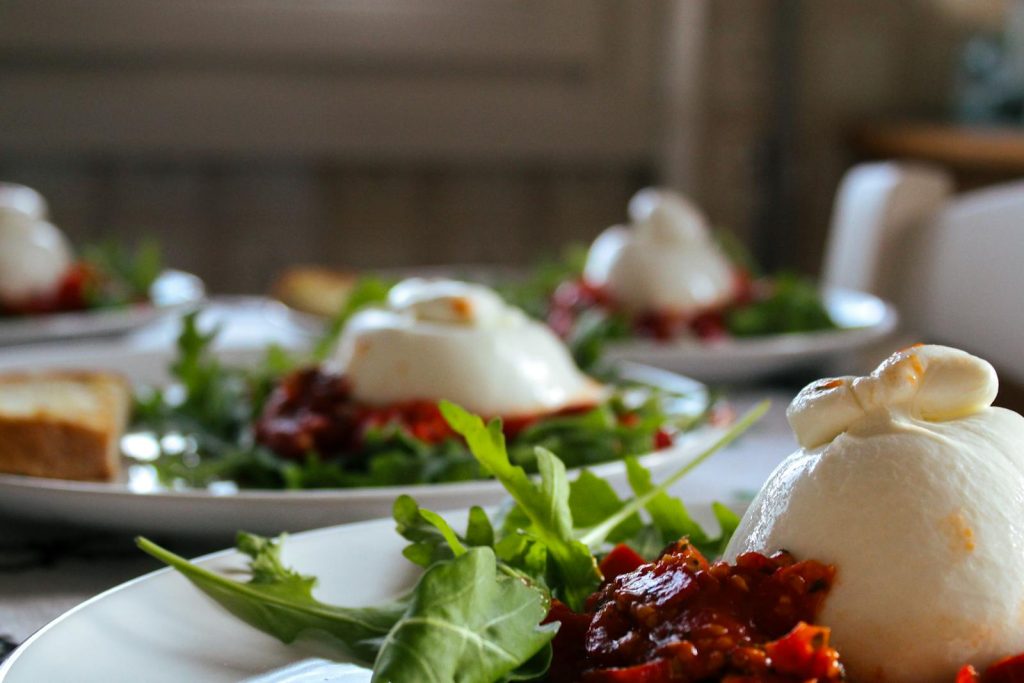
On the outside, burrata looks just like a ball of mozzarella: a thin, elastic layer of pasta filata (the stretched curd that also makes mozzarella). But when you cut into a burrata, something special happens: it opens up and a creamy, stringy filling flows out. That filling is called stracciatella: loose shreds of mozzarella mixed with cream.
Burrata was only invented in 1956, making it a genuinely young newcomer compared to Italy’s centuries-old cheese classics. The cheesemaker is said to have started with leftover mozzarella curd and cream, a clever way to waste nothing. It has since become a global culinary star.
An aged cousin from the pasta-filata family: read our article on provolone.
What’s the difference between burrata and mozzarella?
Two white balls that look alike, but the experience is completely different:
- Mozzarella: a fully solid, elastic ball of pasta filata. Firm all the way through. A mild, milky-salty flavor.
- Burrata: the same pasta filata shell on the outside, but filled inside with stracciatella and cream. Much creamier and richer in flavor. When you cut into it, it spills open, a dramatic moment at the table.
If mozzarella is a quiet soprano, burrata is the whole opera. For the base of a caprese or a pizza Margherita, go with mozzarella. For a show-stopping starter on a plate with great tomatoes, pear, or roasted mushrooms: burrata. Read more about mozzarella on our page what is mozzarella.
How burrata is made
The process combines pasta filata craftsmanship with hands-on assembly:
- The shell: cow’s milk (sometimes buffalo milk) is curdled, cut, and kneaded in hot water into an elastic pasta filata mass, just like mozzarella.
- Shaping: a small “pouch” is formed from that mass, like folding a balloon, with a knot at the top and a cavity at the bottom.
- The filling: stracciatella (torn mozzarella pieces) mixed with fresh cream is spooned into the cavity.
- Sealing: the pouch is tied shut at the top, which creates the characteristic knot or “topknot” you see on a burrata.
- Packaging: stored in its own whey or lightly salted water. Eat within 24 to 48 hours of production for the best result.
Stracciatella, burrata or mozzarella: three related cheeses
A quick guide to telling them apart:
- Mozzarella: a firm pasta filata ball. Completely solid inside.
- Stracciatella: the loose, creamy filling of a burrata, mozzarella shreds in cream. Also sold on its own, perfect over pizza or pasta.
- Burrata: a mozzarella shell with stracciatella inside. The best of both.
Not to be confused with Italian stracciatella alla romana (a Roman egg soup with Parmesan) or stracciatella ice cream (chocolate flakes in vanilla ice cream). Three completely different things that happen to share the name “stracciatella.”
Is burrata healthy?
Burrata is not a light cheese:
- Protein: 15 to 18 grams per 100 grams. Solid.
- Fat: 20 to 25 grams per 100 grams, noticeably higher than mozzarella due to the added cream.
- Calcium: a good source, comparable to other fresh cow’s milk cheeses.
- Lactose: burrata contains lactose and is not suitable for people with severe lactose intolerance. Aged cheeses like Parmigiano Reggiano or Pecorino are a better choice in that case.
- Fresh and short-lived: the opposite of a long-aged cheese. The flavor changes within 48 hours of opening.
It’s a cheese to enjoy mindfully, for a special dish rather than everyday eating.
Burrata during pregnancy: what’s the advice?
The same principle applies as with mozzarella: it comes down to pasteurization.
- Pasteurized burrata: safe during pregnancy. Pasteurization of the milk kills any Listeria.
- Raw-milk burrata (often artisanal Italian versions): avoid. The short aging time, high moisture content, and added cream create conditions where Listeria can multiply.
Always check the label for “pastorizzato” or “gepasteuriseerd.” Many Italian delicatessens sell artisanal raw-milk burrata, which is delicious, but not suitable during pregnancy. A safe alternative for Italian-style cooking: choose an aged hard cheese like Parmigiano Reggiano.
See also our article on cheese during pregnancy — we explain per cheese type what is safe and what to avoid.
What goes well with burrata?
Burrata is a star on the plate. A few classic and modern pairings:
- With tomatoes: the simplest and best combination. Sun-ripened tomatoes, good olive oil, basil, salt and pepper. Sometimes a drizzle of balsamic glaze. Done.
- With peach or fig: sweet stone fruit and burrata are a surprisingly great match, especially in summer.
- On roasted vegetables: squash, bell pepper, zucchini, celeriac. The warm vegetables gently soften the outer shell.
- On pizza: after baking only. You can’t bake burrata; the heat destroys its signature texture. Place it whole on the hot pizza and let it slowly open up.
- On pasta: place a whole burrata in the center of a pasta dish (especially simple pasta with tomato sauce). Cut it open at the table.
- With quality cured ham: prosciutto di Parma or San Daniele.
- In a salad: with arugula, pear, walnuts, and a honey-mustard dressing.
One important tip: always serve burrata at room temperature. Take it out of the fridge 30 minutes before serving. Cold burrata tastes like nothing.
More ideas in our article on putting together a cheese board.
Our Italian cheeses
Fresh burrata isn’t part of our standard range at Cheese In A Box. Like mozzarella, fresh burrata requires a daily supply chain that doesn’t fit our fresh-cut-on-order approach. That said, if you want to put together an Italian cheese board at home or host a pasta night, we do stock other classics:
- Parmigiano Reggiano, the king of Italian cheeses, long-aged and intensely flavorful.
- Pecorino, Italian sheep cheese, a classic with pasta dishes.
- Gorgonzola Dolce and Gorgonzola, Italy’s iconic blue cheeses.
Want to discover a new artisanal cheese every month? Our cheese subscription brings a surprising selection of cheeses, Italian and international, straight to your door with every delivery.
{ “@context”: “https://schema.org”, “@type”: “FAQPage”, “mainEntity”: [ { “@type”: “Question”, “name”: “What’s the difference between burrata and mozzarella?”, “acceptedAnswer”: { “@type”: “Answer”, “text”: “Mozzarella is a fully solid, elastic pasta filata ball. Burrata has the same pasta filata shell on the outside, but is filled inside with stracciatella (mozzarella shreds in cream). When you cut into it, burrata spills open and delivers a much creamier, richer result than mozzarella.” } }, { “@type”: “Question”, “name”: “What’s inside a burrata?”, “acceptedAnswer”: { “@type”: “Answer”, “text”: “The outside is a thin shell of pasta filata (like mozzarella). The inside is filled with stracciatella: loose mozzarella shreds mixed with fresh cream. When you cut into it, that creamy filling spills out, which is what creates the characteristic open-and-pour presentation.” } }, { “@type”: “Question”, “name”: “Is it safe to eat burrata during pregnancy?”, “acceptedAnswer”: { “@type”: “Answer”, “text”: “Pasteurized burrata is safe during pregnancy. Pasteurization kills Listeria. Raw-milk burrata (often artisanal Italian versions) should be avoided, because the high moisture content and added cream create favorable conditions for Listeria. Always check the label for ‘pastorizzato’ or ‘gepasteuriseerd’.” } }, { “@type”: “Question”, “name”: “What’s the best way to serve burrata?”, “acceptedAnswer”: { “@type”: “Answer”, “text”: “Always serve burrata at room temperature. Take it out of the fridge 30 minutes before eating. Classic pairings: sun-ripened tomatoes, basil, and good olive oil. More modern combinations: with peach or fig, on roasted vegetables, with prosciutto, or placed whole in the center of a simple pasta. On pizza, only after baking, never bake it.” } }, { “@type”: “Question”, “name”: “What exactly is stracciatella?”, “acceptedAnswer”: { “@type”: “Answer”, “text”: “Stracciatella is the creamy filling of a burrata: loose mozzarella shreds mixed with fresh cream. It’s also sold on its own, and works beautifully over pizza, pasta, or roasted vegetables. Don’t confuse it with stracciatella alla romana (a Roman egg soup) or stracciatella ice cream (chocolate flakes in vanilla ice cream). Three completely different products that happen to share the same name.” } } ] }Strong in our shop: see also our article on Dutch farmhouse cheese.